
Product Features
Capabilities
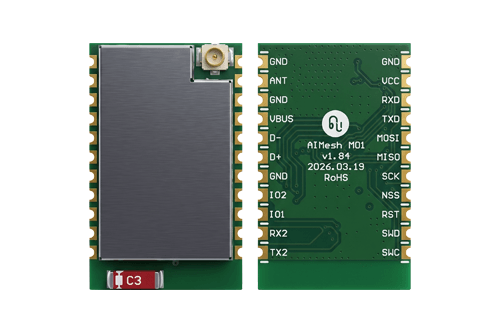
The AIMesh M01 wireless module is the smallest access unit in the AISENZ AIMesh 2.5 industrial wireless sensor network, designed for embedding wireless connectivity into industrial instruments, sensors and actuators. Built on an ARM Cortex-M4 with FPU and a 2.4 GHz ISM radio, it runs the full IEEE 802.15.4e TSCH + 6TiSCH + IPv6 stack. A single module brings Modbus RTU instruments, temperature and humidity sensors, vibration sensors and electricity, water and gas meters onto an AIMesh industrial wireless network, giving low-power, high-reliability field data acquisition with deterministic latency.
The 16 × 26 × 2.5 mm SMT package lets OEMs integrate the module using a standard reflow process, shortening development cycles. The AIMesh 2.5 stack is built in: the module joins the network at power-up, with no manual network configuration needed to become part of a large-scale industrial IoT deployment.
Core characteristics
- Ultra-low power: over five years of maintenance-free battery operation at a routine reporting rate, up to ten years at a low one, suited to remote, dispersed sites where mains power is impractical
- Routing / leaf dual mode: switchable by parameter — externally powered nodes take on routing duty automatically, forming a self-organising mesh topology
- Dual UART host interface: UART1 exposes AT commands, UART2 carries Modbus RTU or a raw binary stream, so existing instrument protocols work unchanged
- Bluetooth + app commissioning: field engineers set PAN ID, node type and transmit power from a phone app, without opening the cabinet
- Industrial temperature range: −40 °C to +85 °C operating, for outdoor, plant-floor and equipment-room environments
- AIMesh 2.5 stack: native IPv6 addressing, 6TiSCH slot scheduling and RPL routing, with end-to-end delivery reliability of 99.99% or better
Deployment parameters
During commissioning, engineers configure the following over AT commands or the Bluetooth app:
- PAN ID: separates IEEE 802.15.4e network instances so co-located AIMesh networks do not interfere with each other
- Node type: sets the routing role — externally powered devices should be routing nodes, battery-powered devices leaf nodes, which balances power draw against topology coverage
- Transmit power: adjustable 0–12.5 dBm (10 dBm default), set according to site distance and penetration requirements
- Slotframe length: 2/4/8/16/32/64/128 (units of 100 ms). Backbone routing nodes are typically 4–8 for low latency, remote routers 16–32 to balance power, and leaf nodes 64–128 for maximum battery life
Typical applications
The M01 module is deployed at scale across industrial IoT scenarios, and suits customers who need long battery life plus OEM integration:
- Smart water: remote water meters, pressure transmitters, flow meters
- Smart energy: distributed electricity meters, thermostatic valves, energy data collectors
- Smart plants: vibration sensors, temperature and humidity monitoring, equipment health monitoring (PHM)
- Smart buildings: environmental monitoring, personnel location, energy metering
- Hazardous chemical safety: combustible gas detection, temperature and pressure alarms, situational awareness
Compared with conventional short-range wireless
Against ZigBee, Wi-Fi and BLE Mesh, AIMesh M01 holds clear advantages in large-scale industrial deployments: thousands of nodes on a single network, deterministic end-to-end latency of 200 ms or less, six-year battery life across the network, and native IPv6 that integrates directly with enterprise IT — a next-generation low-power industrial wireless access layer for Industry 4.0, smart manufacturing and smart cities.
Key specifications
Engineering Credibility
Engineering guidance
Applications
Suits rapid productisation of low-power endpoints for pressure, temperature, level, door contact, water leak and electrical parameters.
Where the instrument has a host MCU or room for a battery, M01 serves as the embedded communication core.
Points with a power supply can act as routing nodes to strengthen coverage and network stability.
Deployment models
Protocols
Specification checkpoints
- Confirm whether each node is a leaf or a router — routing nodes draw noticeably more power.
- Keep the antenna clear of metal obstruction and strong electrical interference.
- Estimate battery life from sampling, reporting, retransmission and low-temperature derating together.
Selection guidance
- Choose M01 for a standalone sensing endpoint; choose M840 for board-level OEM designs.
- Choose D01 to connect existing RS485 instruments.
- Choose AP01 for gateway and border routing duty.
Reference topology
M01 endpoints are distributed across the site as AIMesh nodes, AP01 aggregates the network, ECS handles network operations, and business data flows into the upper-layer platform.
Common pitfalls
- Putting every node in leaf mode, leaving the network without usable routers once obstructions appear.
- Leaving no margin for reduced battery capacity at low temperature, so winter replacement intervals exceed expectations.
- Not standardising device codes and installation locations, which makes later alarms hard to localise.
Standards & interface specifications
Related case studies
500+ wellheads connected, with a 65% cost reduction on wireless retrofit in mature well areas.
Case studiesAIMesh monitoring for 200 MW of rooftop PV, east ChinaLow-cost wireless access across many sites, with a 78% cost reduction per site.