
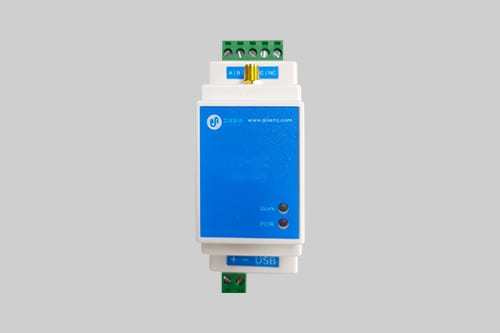
Product Features
Capabilities
The AIMesh D01 industrial DTU module is a wireless data transfer unit built by AISENZ for connecting existing Modbus instruments. Through a single RS485 interface it connects electricity, water and gas meters, transmitters, PLCs and controllers already installed in the field, bringing them onto the AIMesh 2.5 industrial wireless network with no modification to the instrument. Existing assets become remotely monitorable and remotely serviceable, which makes D01 well suited to brownfield plant upgrades, smart water, smart energy and municipal infrastructure programmes.
D01 also works as a standalone relay routing node. In areas of weak coverage or topological dead spots, deploying D01 alone extends AIMesh coverage, improves the multi-hop routing structure and raises overall network reliability. The ABS industrial enclosure and 35 mm DIN rail mounting allow installation right inside instrument boxes, distribution cabinets or field terminal boxes.
Core characteristics
- RS485 + Modbus RTU: one industrial RS485 interface supporting Modbus RTU master, slave and transparent modes, compatible with well over 99% of Modbus devices on the market
- AIMesh 2.5 wireless backhaul: 2.4 GHz ISM, 12.5 dBm transmit power and −106 dBm receive sensitivity for long-range, low-power transmission with deterministic latency
- Bluetooth + app commissioning: no wiring and no laptop required — engineers set PAN ID, node role, serial parameters and the Modbus register map from a phone app
- USB Type-B configuration port: supplies power and accepts AT commands at the same time, convenient for lab bring-up and batch factory programming
- Industrial reliability: −40 °C to +85 °C operation, ABS industrial enclosure and a standard SMA-K 50 Ω antenna connector for demanding field environments
- Usable as a routing node: with power alone it can be deployed as an AIMesh relay router, adding network depth and redundancy
Typical deployment patterns
Three patterns are common in the field:
- Making existing Modbus instruments wireless: D01 connects over RS485 to meters and transmitters and backhauls wirelessly to an AIMesh AP01, then to an E680 edge gateway and on to SCADA, MES or an IoT platform
- Remote PLC I/O: D01 connects to a PLC RS485 port for wireless uplink of PLC data and remote configuration downlink
- Network relay extension: in large plants, long utility corridors and underground spaces, D01 is deployed as an AIMesh routing node to extend coverage
Selection considerations
Against conventional 4G, LoRa and NB-IoT DTUs, AIMesh D01 differs in several respects:
- No subscription and no infrastructure dependency: the network is self-formed, with no carrier network or data plan required, which suits private campus deployments
- Deterministic average latency of 1 s or less: 6TiSCH slot scheduling protects the timeliness of critical control traffic
- Network-wide IPv6 addressing: each D01 and the Modbus devices behind it can hold a global IPv6 address, so the cloud can address and service them directly
- Six years maintenance-free: with a suitable power supply the unit runs long-term without servicing
Industries served
AIMesh D01 is widely deployed in smart water (remote water meters, pressure monitoring, secondary pumping stations), smart energy (distributed electricity meters, PV combiner boxes, storage BMS), smart manufacturing (data acquisition from existing workshop equipment, energy management) and municipal infrastructure (smart manhole covers, bridge structural monitoring, smart street lighting), making it a key tool for digitising installed industrial assets.
Key specifications
Engineering Credibility
Engineering guidance
Applications
Brings electricity, water and gas meters, transmitters, PLCs and controllers onto an AIMesh network.
No need to replace instruments or cabling — a D01 nearby provides the wireless backhaul.
Where power is available it acts as a routing node, improving coverage and link quality.
Deployment models
- D01 connects to field instruments over RS485, with Modbus address, baud rate and register map configured.
- AT command configuration, debugging and batch parameter programming are done over USB Type-B or an engineering tool.
- Once D01 joins an AP01, the upper-layer platform reads data by raw or normalised register map.
Protocols
Specification checkpoints
- Verify instrument address, baud rate, parity, register map and polling interval.
- RS485 bus length, termination resistors, shield grounding and surge protection must follow site wiring practice.
- Keep power and antenna runs from paralleling high-voltage cabling over long distances.
Selection guidance
- Choose D01 where RS485 instruments already exist.
- Choose M01 or M840 when designing a new low-power sensing endpoint.
- Choose G001/G008 or R580 when multi-channel acquisition, interlocking or edge logic is required.
Reference topology
Existing Modbus instruments connect to D01, D01 carries the data onto the AIMesh network, and AP01 aggregates it into SCADA/HMI, ECS or the customer platform.
Common pitfalls
- Starting installation before the register map is settled, so point meanings and ranges are revised repeatedly after go-live.
- Omitting isolation and surge protection on RS485 wiring, raising fault rates in the storm season.
- Setting acquisition intervals too tight, so low-value data consumes wireless network capacity.
Standards & interface specifications
Related case studies
500+ wellheads connected, with a 65% cost reduction on wireless retrofit in mature well areas.
Case studiesEnvironmental monitoring across 120 substations, south ChinaUnattended station retrofit, cutting alarm response from 45 minutes to 7.