
Product Features
Capabilities
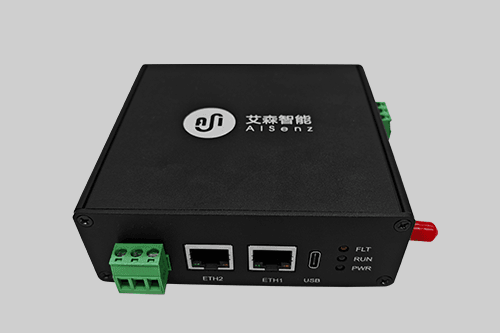
The AIMesh AP01 border router gateway is an industrial AIMesh access point built by AISENZ for industrial wireless IoT, doubling as the border router (6LoWPAN border router) between the AIMesh 2.5 wireless network and the wired IPv6 backbone. It runs a 3× Cortex-A7 @ 1.5 GHz processor with a 2.4 GHz ISM radio, +19 dBm transmit power and −111 dBm receive sensitivity, and a single unit carries wireless access and backhaul for several hundred AIMesh mote nodes.
Within an AIMesh network, AP01 acts as the 6TiSCH root node / border router. Downstream it forms a self-organising mesh subnet with M01 modules and D01 data transmission units over IEEE 802.15.4e TSCH; upstream it connects to the enterprise IPv6 backbone over Gigabit Ethernet, or to an E680 edge computing gateway, delivering large-scale industrial wireless coverage at plant or campus scale.
Core characteristics
- Triple-core processor: 3× Cortex-A7 @ 1.5 GHz with heterogeneous scheduling, supporting hundreds of nodes joining and reporting concurrently on one unit
- Long-range industrial radio: +19 dBm transmit power with −111 dBm receive sensitivity gives line-of-sight coverage of several hundred metres per AP, with better penetration than comparable Wi-Fi
- IPv6 border routing: native 6LoWPAN / 6TiSCH lets AIMesh nodes integrate directly with enterprise IT, with no NAT or gateway protocol conversion
- Dual Gigabit Ethernet: supports network redundancy, VLANs and separated uplink/downlink deployment for industrial reliability requirements
- RS485 + USB expansion: connects local PLCs, HMIs and Modbus instruments, letting the unit serve as an edge aggregation gateway
- DIN rail, industrial temperature range: 35 mm DIN rail mounting, ABS and metal enclosure, −40 °C to +85 °C operation, suitable for switchgear cabinets, plant floors and outdoor enclosures
Elastic scaling and resilient networking
Several AIMesh AP01 units build one large AIMesh wireless network covering an entire campus, workshop or municipal district:
- Elastic expansion: add APs as needed; a new access point joins the existing AIMesh network with zero configuration, so capacity grows smoothly
- Linear capacity growth: each AP subnet performs its own TSCH slot scheduling without interfering with the others, so total throughput scales linearly with AP count
- High-quality coverage: overlapping areas between adjacent APs create redundant paths, and mote nodes move between APs without interruption, protecting critical acquisition traffic
- Service availability: 6TiSCH routing combined with RPL self-healing switches over within seconds when an AP link fails, sustaining 99.99% end-to-end reliability
Typical deployments
AIMesh AP01 is widely deployed across industrial IoT scenarios:
- Smart plants and industrial parks: combined with M01 and E680 into an integrated sensing, access and edge computing solution carrying equipment condition monitoring, energy data acquisition and PHM failure prediction
- Smart buildings and commercial complexes: covering HVAC, power, fire safety and security subsystems, aggregated onto a single IPv6 IT network
- Campuses, hospitals and laboratories: environmental monitoring, hazardous chemical safety, personnel and asset location, medical equipment management
- Municipal and smart city: smart street lighting, manhole cover monitoring, smart parking, bridge and tunnel structural health monitoring
Compared with conventional industrial wireless gateways
Against LoRaWAN gateways, Wi-Fi APs and traditional ZigBee coordinators, AIMesh AP01 brings distinct advantages to critical industrial scenarios: native IPv6, deterministic latency, a self-organising and self-healing mesh, six-year battery life for end nodes, and thousand-node capacity per network. It is the core border device for building an AIMesh 2.5 industrial wireless sensor network on a 6TiSCH IPv6 architecture.
Key specifications
Engineering Credibility
Engineering guidance
Applications
Connects low-power wireless nodes to wired IPv6 and Ethernet networks.
Provides wireless coverage across well pads, station buildings, rooftop PV arrays and pumping stations.
Deploying multiple AP01 units by zone reduces hop count and improves reliability and operational visibility.
Deployment models
- Installed in station buildings, on poles, in control cabinets or outdoor enclosures, favouring line of sight and stable power.
- Downstream it accepts M01, D01 and M840 nodes; upstream it connects to E680, SCADA, ECS or the customer network.
- Multiple AP01 units are planned by geographic zone, avoiding oversized single-AP coverage that raises hop count and retransmission.
Protocols
Specification checkpoints
- Check port count, power budget, enclosure protection rating and mounting method against the site.
- Plan AP placement against obstructions and hop count rather than raw distance.
- Confirm the uplink path and its redundancy before commissioning.
Selection guidance
- Choose AP01 wherever AIMesh needs a border router to a wired network.
- Choose E680 when protocol aggregation and edge applications are also required.
- Choose D01 as a relay when only coverage extension is needed.
Reference topology
M01 and D01 nodes join AP01 over AIMesh, AP01 bridges to the wired IPv6 network, and data continues to E680, SCADA or the customer platform.
Common pitfalls
- Covering too large an area with one AP, which drives up hop count and retransmission.
- Ignoring power and surge protection in outdoor enclosures.
- Failing to verify uplink stability, so wireless problems are misdiagnosed as node faults.
Standards & interface specifications
Related case studies
500+ wellheads connected, with a 65% cost reduction on wireless retrofit in mature well areas.
Case studiesAIMesh monitoring for 200 MW of rooftop PV, east ChinaLow-cost wireless access across many sites, with a 78% cost reduction per site.